
Online Handwriting Review and Sample Analysis
A handwriting review examines the learner's writing before training begins, checking formation, spacing, alignment, cursive flow, neatness and speed. The trainer identifies the main correction priorities and uses those findings to explain suitable methods and next steps.
- Uses learner's actual handwriting
- Formation and spacing checked
- Alignment and cursive flow checked
- Main correction priorities identified
- Methods chosen from review findings
- Next-step guidance after review
| Review | : | Handwriting review and sample analysis |
|---|---|---|
| Writing | : | Based on the learner's actual writing |
| Checks | : | Formation, spacing, alignment and flow |
| Priority | : | Main correction needs are identified |
| Trainer | : | Trainer reviews the writing sample |
| Method | : | Methods chosen from review findings |
| Feedback | : | Next-step guidance is explained |
| Fit | : | Learner fit checked before training |
| Demo | : | Free 30-minute demo available |
| Next | : | Send sample or book a demo |
What a Natural Handwriting Sample Can Reveal
A normal writing sample shows the learner’s real habits more clearly than a slow or carefully copied practice page. A handwriting assessment online can identify visible priorities from a current sample, while handwriting sample analysis online helps narrow the first correction focus.
- The review checks visible patterns such as formation, spacing, alignment, line use, cursive flow, neatness and pace without trying to fix everything at once.
- The trainer identifies the issue that most affects readability or consistency, giving the learner a practical first correction priority.
- After the review, the next step may be a focused practice direction, a free demo or regular guidance depending on the amount of correction needed.
A writing-sample review checks visible handwriting habits and training priorities without presenting the review as a.
The trainer can observe letter formation, spacing, alignment, line use, cursive flow, neatness and visible pace from the learner’s normal writing.
These observations help identify the correction areas that most affect readability and decide which practice methods may be suitable to start with.
A handwriting review online is educational handwriting guidance only; it does not diagnose medical, psychological, developmental or learning conditions.
How a Writing Sample Review Guides Correction
A sample review should identify visible handwriting priorities and guide the next practice step without making diagnostic claims.
The trainer can observe letter formation, spacing, alignment, baseline use, cursive flow, neatness and visible pace from the learner’s normal handwriting sample.
Those observations identify which habits most affect readability, allowing suitable correction methods and practice priorities to be explained in a practical order.
The review remains educational handwriting guidance only; it does not diagnose medical, developmental, psychological, learning or occupational-therapy conditions.
Writing Sample Review Progress Examples
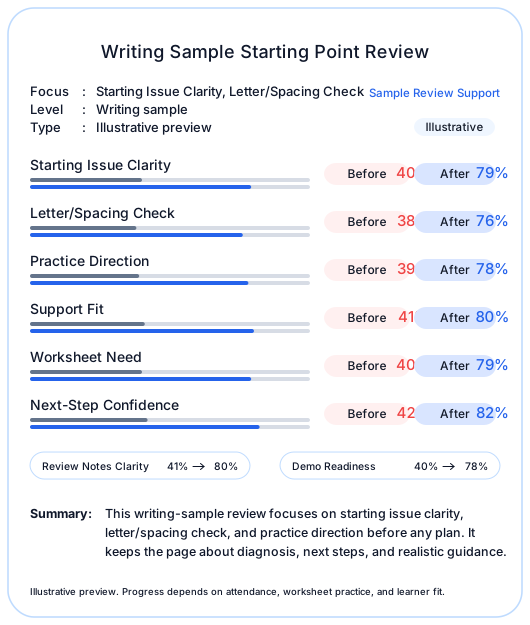
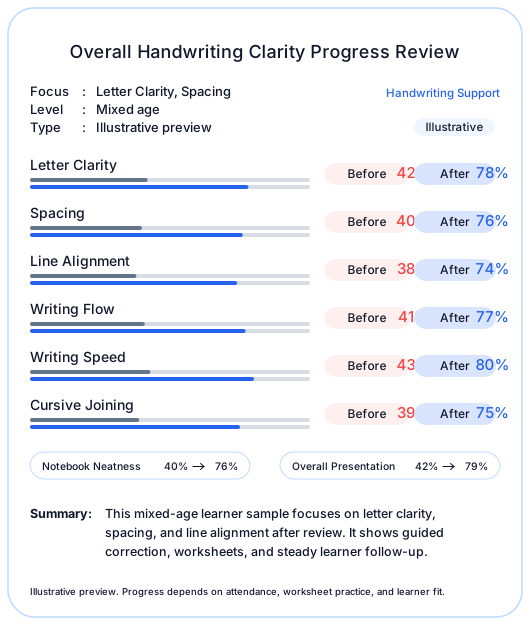
Sample cards show how a current writing issue can be identified, explained and linked to a suitable correction and practice direction.
Preparing a Useful Handwriting Sample for Review
A recent natural sample gives the trainer a clearer view of writing habits than a specially corrected or copied page.
- Send a recent paragraph or notebook sample that shows the learner’s normal writing across several lines.
- Use a clear photo in good light so letter shape, spacing, baseline and page layout can be reviewed.
- Choose writing produced at the learner’s usual pace, not a page rewritten slowly only to look extra neat.
- Mention one main concern, such as spacing, cursive flow, neatness, speed or page presentation.
How Review Selects the First Correction Focus
The first correction target is the writing habit that most affects practical readability, not simply the feature that looks easiest to change.
When letters are difficult to recognise, formation, size and stroke consistency come before speed work because clearer shapes are the basic reading requirement.
When letters are readable but words crowd together, spacing and line organisation can be corrected before asking the learner to increase writing pace.
When writing is neat slowly but unclear at normal speed, compare a natural faster sample and work on rhythm, spacing and movement efficiency together.
After the first target becomes steadier, review a fresh sample to decide whether the next focus should be speed, joins, page presentation or another remaining pattern.
Details That Make a Writing Review More Useful
A useful sample review depends on seeing normal writing clearly and knowing enough context to judge the main concern fairly.
- Send a recent page showing usual writing, not a specially cleaned-up sample made only for review.
- Use a clear, well-lit photo so letter shapes, word gaps, baselines and page layout are easy to see.
- Mention age or class so expectations for formation, speed and writing load match the learner’s stage.
- State the main concern, such as slow writing, unclear letters, uneven spacing or exam-speed pressure.
A handwriting review should finish with one useful educational action based on what the writing sample actually shows.
Use focused practice when one visible writing habit can be corrected clearly before a broader plan is needed.
Use a demo when the learner benefits from seeing the correction explained while writing rather than only reading advice.
Choose regular guidance when several related handwriting habits need structured practice, worksheets and review over time.
Review a fresh sample after practice to see whether the correction is transferring into normal writing before adding another target.
The review turns visible handwriting observations into a practical correction priority, so later guidance is based on evidence rather than guesswork.
Are common letters recognizable, and do repeated letters keep a reasonably consistent shape? within the review workflow.
Are words clearly separated, or do letters and words crowd together as the line continues? within the review workflow.
Does letter size stay reasonably stable, and does the writing sit consistently on the line? within the review workflow.
Do slant and cursive joins support readable flow, or do they make letters harder to distinguish? within the review workflow.
If a natural or timed sample is available, does readability change when the learner writes faster? within the review workflow.
Are margins, line gaps, headings and answer spacing helping the page stay easy to read? within the review workflow.
A handwriting review turns current writing into a first priority before a demo or regular support is chosen.
A sample review gives a practical first opinion before the learner books a demo or support.
Real handwriting often shows the main concern more clearly than a general description.
The review helps decide whether a demo, guided support or another page should come first.
Starting from actual writing gives the next decision more evidence than a general enquiry.
The review provides practical correction direction from the writing you send, rather than a long theory report or a medical-style assessment.
- A concise description of the most visible handwriting pattern affecting clarity, consistency or comfortable writing.
- One or more correction priorities arranged in a useful order so practice starts with the highest-impact writing habit.
- A next-step suggestion, such as focused practice, a free demo or regular guided support when continued correction is appropriate.
- A clear boundary: handwriting review is educational guidance and does not diagnose medical, developmental, psychological or learning conditions.
Not every learner needs the same order, but this sequence is a useful way to avoid increasing speed before the writing is stable enough to stay readable.
- Readability first: correct letter shapes or spacing that make words difficult to recognize.
- Consistency next: stabilize size, baseline, spacing or joins across more than a few lines.
- Speed after stability: increase pace gradually and check whether the same readable pattern survives in normal schoolwork, notes or timed writing.
A single careful page can hide the exact habit that appears when the learner writes naturally or under time pressure.
When possible, compare a normal everyday sample with a second sample written at the pace that causes difficulty. The difference can reveal whether spacing, size, joins or line control changes as speed increases.
For younger learners, a short natural paragraph may be enough. For older students or adults, a notebook page, notes or a timed paragraph can provide more realistic context.
The review should describe the visible difference between the samples and choose a practical first target. It should not turn handwriting appearance into a personality judgment or clinical diagnosis.
A later recheck is most useful when it uses similar writing conditions, because that makes the change easier to compare fairly.
Practical review guide
A useful handwriting review stays with visible writing patterns, identifies one practical priority and avoids medical, personality or guaranteed-result claims.
Look at observable details such as letter formation, spacing, size, baseline, joins, slant and page organization. Do not infer personality, diagnosis or learning conditions from appearance.
When several issues appear together, begin with the feature that most affects readability or consistency. A focused target is easier to practise than correcting everything at once.
If speed is part of the concern, review writing produced at the pace where the problem appears. An unusually slow neat sample may hide the habits seen in normal classwork or notes.
Progress is easier to judge when later samples use a reasonably similar task, paper format and writing pace. The comparison should show practical change, not manufacture a dramatic result.
What kind of handwriting sample is most useful?
Send recent normal writing. If speed changes the handwriting, include a sample written at the pace where the clarity problem usually appears.
Can one sample identify the cause of poor handwriting?
No. A sample can show visible writing habits, but it cannot reliably identify every underlying cause or provide a medical, developmental or learning diagnosis.
Should faster writing always be the first goal?
No. When faster writing reduces letter clarity or spacing, stabilize the most important readability issue before increasing pace.
Can a writing review guarantee a fixed improvement time?
No. Progress varies with the starting pattern, learner fit, attendance, practice consistency and how well the correction transfers to everyday writing.
What a Handwriting Review Can Reliably Show
A review is useful for educational handwriting guidance when conclusions stay limited to patterns that are visible in the submitted writing.
- It can identify visible habits such as unclear letter forms, crowded spacing, changing size, unstable baselines, difficult joins or reduced readability when writing faster.
- It can help select the first writing habit to practise and indicate whether a live demo or regular correction support may be a useful next step.
- It cannot diagnose dysgraphia, motor disorders, learning disabilities, psychological traits or medical conditions from handwriting, and it cannot promise a fixed result or completion time.
Questions About the Writing Review
These answers explain what to send, what the review can show, and how a demo or regular guidance may follow.
Can I send handwriting before making a payment?
Yes. A recent writing sample can be reviewed before payment so the team can explain the first visible correction priority and suggest an appropriate next step.
How much handwriting should I send for review?
Usually one short, clear and recent sample is enough to begin. Natural everyday writing is more useful than a specially prepared neat page.
Do I need special paper or a fixed sample format?
No. A normal recent notebook or paper sample is usually suitable, provided the writing is clear enough to review.
Can I submit a page from a school notebook?
Yes. A normal school notebook page can be useful because it shows the learner’s everyday writing rather than an artificially careful sample.
Will the review explain what I should do next?
Yes. The review is intended to identify a practical first correction direction and clarify whether a demo or another support step may be useful.
Can I book the free demo after my sample is reviewed?
Yes. After the review, you can still book the one-time free 30-minute demo to experience the live guidance format before deciding on regular support.
Will I receive a long formal handwriting report?
No. This is a practical educational review designed to give an initial direction from the visible writing sample, not a long diagnostic report.
Is the writing review a clinical or learning assessment?
No. It reviews visible handwriting habits for educational guidance. It does not diagnose medical, psychological, motor or learning conditions from handwriting.
Use these pages when you want to understand the process, share another sample, try live guidance, review examples or ask for help.
- Read How CursiveClasses.in Works to understand the free-demo, learner-fit and payment-after-confirmation process.
- Use send writing sample when you have a recent page ready for review.
- Book a demo session when live trainer interaction is the next useful check.
- View results for progress examples that show change without promising the same outcome for every learner.
- Open the contact page when you want help choosing between review, demo or another suitable next step.
Use the review to identify a practical first correction direction, then choose a sample, demo or program route after the learner’s needs and fit are clearer.


